2023-present (planned completion: 2027)
Prediction of continuous arterial blood pressure signal based on photopletysmography and individual patient characteristics
PhD project - Bartosz Olszewski, MSc (supervisor: Magdalena Kasprowicz, PhD DSc)
Implementation doctorate (Ministry of Science and Higher Education, submission no DWD/7/0063/2023)
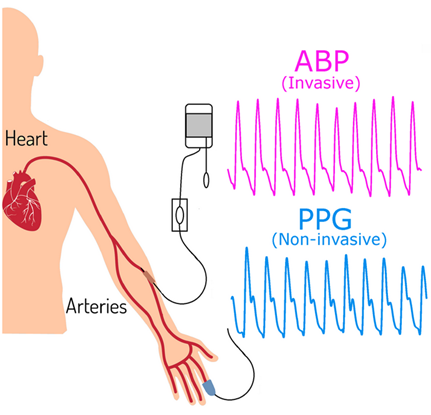
According to data from the Central Statistical Office from 2021, cardiovascular diseases are responsible for over one-third of deaths in Poland. A key aspect of diagnosing cardiovascular conditions is the continuous measurement of arterial blood pressure (ABP). The most accurate ABP signal is obtained through invasive measurement, which, however, causes patient discomfort and carries a risk of complications. An alternative is non-invasive methods, but these have drawbacks: either they do not allow for continuous measurement (as in the case of a sphygmomanometer) or the devices that enable continuous ABP monitoring are expensive. A potential solution is the use of a photoplethysmographic (PPG) sensor, which is relatively inexpensive and can measure changes in blood volume within a blood vessel in a non-invasive and continuous manner.
The scientific objective of the project is to verify the hypothesis that, based on non-invasively measured data obtained via PPG, along with individual patient variability factors (such as age, sex, and BMI), it is possible to achieve a better estimation of continuous blood pressure signal variations.
The practical goal is to design a cost-effective and real-world applicable non-invasive method for continuous blood pressure monitoring. The method will be implemented in the Cardiolens FFR-CT Pro® system by Hemolens®, which requires continuous blood pressure monitoring as an individual variability factor for assessing the anatomical and functional state of the coronary arteries. Unlike traditional coronary angiography, Cardiolens FFR-CT Pro® is a non-invasive method that does not require hospitalization, reducing costs, the risk of complications, and patient discomfort.